
In this blog series, Arlo CEO Chris Teeling shares the stories of Arlo customers and the incredible impact they’re making through training, the future of learning and why instructor-led training matters more than ever.
The future of training is more than instructor-led training
I’ve shared my conviction that in a world increasingly shaped by AI, the “human-in-the-loop” advantage of instructor-led training will only become more important. The expertise, empathy, and connection great trainers bring can’t be replicated.
But here’s an uncomfortable truth: most training businesses don’t grow beyond the founder.
For decades, professional training has followed a familiar, reliable format: a full room, a fixed schedule, and a brilliant trainer at the front. And it worked. But the model has its limits. When growth depends on time in the room, it’s capped by human hours. More courses. More delivery. More pressure on the same people.
The future of training isn’t less instructor-led. It’s more than instructor-led, powered by what we see at Arlo as the next evolution of the model: amplified blended learning.
Amplified blended learning is your multiplier
“Blended learning” as a term has been around for years. But in many instances, it’s been limited to a bit of pre-work here, some follow-up there, or on the other end of the spectrum it is expensive, and rigid to design and deliver.
Amplified blended learning is a step-change from that model. It extends the impact of instructor-led training across the entire learning lifecycle.
Not just content layered on top, but a continuous learning experience:
- Personalised refreshers that reinforce learning over time
- Just-in-time support when learners actually need it
- Ongoing opportunities to return, build skills, and stay engaged
It takes the spark that happens in the room and carries it forward by reinforcing learning, increasing engagement, and creating lasting outcomes without requiring more time in the room.
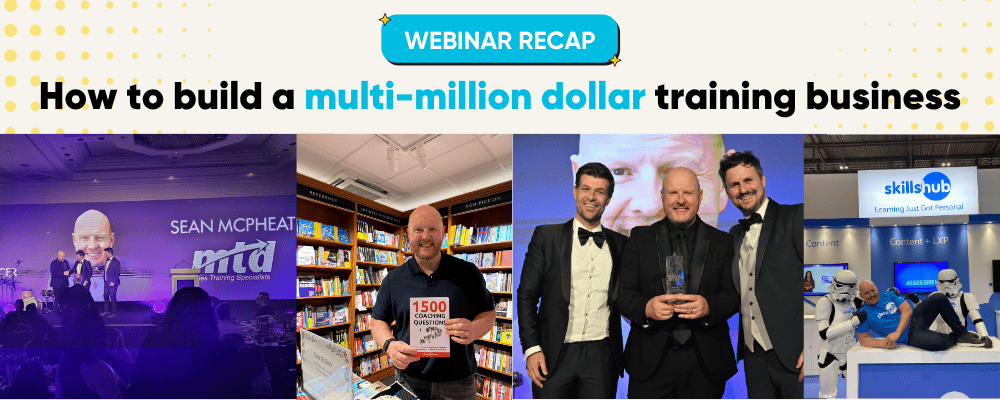
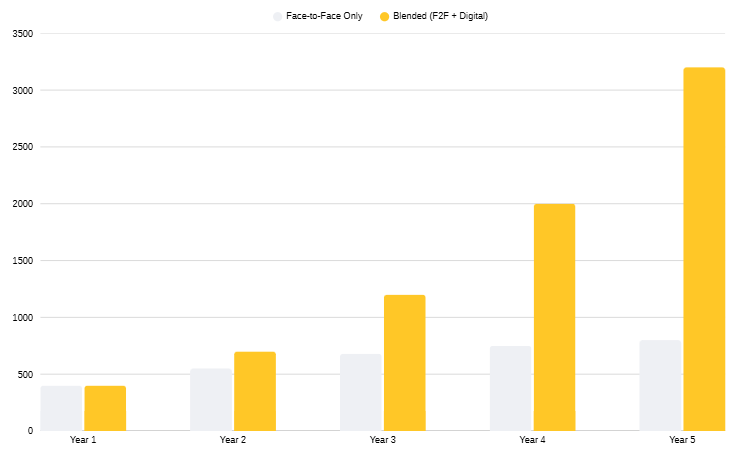
Sean McPheat at MTD Training is a good example of what that looks like in practice. He started like most training businesses do: delivering great face-to-face courses. But the real shift in the business’ growth trajectory was when they moved beyond face-to-face delivery to blended.
By year five, the difference wasn’t incremental. Blended generated 4x the revenue of face-to-face alone.
Instructor-led training still matters. The opportunity now is to build on top of it.
If your business can’t run without you, it doesn’t scale
Sean puts it bluntly: if your business can’t run without you, it doesn’t scale.
But the reality is, scaling instructor-led training is hard.
It relies on your best trainers. It depends on coordinating schedules, managing registrations, handling logistics, and delivering consistently high-quality experiences, often across multiple locations and formats.
Blended can help extend your reach with more learners, more locations and more delivery without being physically present. But if it adds administrative complexity, it’s going to add to your scalability problem.
What changes things is building a model that reduces that complexity. A modern operating approach!
Turning what you deliver into something repeatable. Putting systems around how you sell, deliver, and support training. And making sure your business can scale without adding more manual work at every step.
A modern operating approach
Scaling isn’t just about growth. It’s about removing friction as you grow.
At Arlo, this is exactly what we’re focused on solving.
For over a decade, our foundation has been instructor-led training. We believe it’s critical to how people learn and even more important for future generations.
But to scale that impact, the operating model has to evolve. That means removing the friction that holds training businesses back. Bringing your entire operation into one place. Enabling your team to deliver, manage, and grow without the usual complexity.
We’re all-in on championing the industry and helping it thrive in an AI-driven world. One where training businesses are stronger, reach more learners, and have greater impact than ever before.
Because this shift isn’t just about running more courses. It’s about moving from delivering training to cultivating talent at scale.
In practice, that means:
- Connecting face-to-face and elearning into a single experience
- Making it easy to extend courses with SCORM and AI-powered authoring
- Automating manual work. From registrations and payments to communications and follow-up
- Delivering a consistent, high-quality learner experience from registration through to certification
With our Private Training Portal now in beta, we’re also helping providers remove one of the biggest sources of friction in B2B training delivery: the manual coordination that has historically sat behind private training. It gives clients more visibility and control, while taking repetitive admin off the provider’s plate
When I look at training businesses growing the fastest, two shifts sit at the centre:
- Amplified blended learning, extending the impact of training beyond the room through personalized learning paths and ongoing learning
- A modern operating approach, reducing the reliance on the founder and making delivery repeatable and scalable
Get those right, and growth is no longer limited by human hours. Rather, the sky's the limit.
.svg)