

.svg)
Guest blog post by Zane Huxley on behalf of GEM Compliance Training.
For many SME training providers, marketing is not limited by a lack of ideas. It is limited by capacity. Small marketing teams, limited budgets and increasing pressure to deliver results mean every decision about where to invest time, budget and resources matters. Every training provider wants more enquiries, more bookings and stronger long-term customer relationships, but very few have the capacity to pursue every opportunity.
Unlike larger organisations with specialist marketing functions, many SMEs rely on one or two people to manage websites, search engine optimisation, email marketing, social media, paid advertising, content creation and analytics, often alongside other responsibilities. As marketing channels, platforms and technologies continue to expand, deciding what not to do has become just as important as deciding what to do. Success is no longer determined by doing more marketing. It depends on making better marketing decisions.
Looking back, many of the assumptions we had made about how marketing worked simply didn't reflect how our customers actually bought training. Challenging those assumptions gradually changed the way we approached marketing and helped us build a more focused, strategic function. The four lessons that follow explain the changes in thinking that had the greatest influence on that journey.
Build the brand before you market the courses
Customers have never had more choice or easier access to information. Google's Zero Moment of Truth (ZMOT) argues that purchasing decisions increasingly begin long before a customer speaks to a supplier, with search engines, websites, reviews and online content shaping perceptions throughout the research process. For training providers, this means prospective customers often compare multiple organisations before making contact, evaluating not only the courses on offer but also the credibility of the provider behind them.
For many SME training providers, this creates a strategic challenge. Like many SMEs, much of our marketing naturally revolved around the courses we wanted to fill. However, if customers were primarily comparing providers rather than courses, we needed to understand how those purchasing decisions were really being made.
To better understand how organisations made purchasing decisions, we began analysing our customer journeys. Rather than assuming every customer followed the same path, we identified four broad decision-making journeys based on how customers approached purchasing compliance training. One of the largest groups already knew which course they needed before they reached our website. Their remaining decision wasn't what to buy, but who to trust.

That insight fundamentally changed how we viewed marketing. We realised the problem wasn't the size of our course portfolio; it was the way we were approaching our marketing. We had been asking, "Which course should we promote next?" when the better question was, "How can every marketing activity strengthen the GEM brand?" This shift closely reflects Aaker's Brand Equity Model, which argues that organisations create long-term value by building awareness, trust and positive associations with the brand, rather than relying solely on individual products or services.
Compliance training is rarely an impulse purchase. Organisations are placing responsibility for employee safety, legal compliance and professional competence in the hands of the provider they choose. As providers become easier to compare, trust and familiarity become increasingly valuable competitive advantages. Strong brands help reduce the uncertainty associated with choosing between similar providers, which McKinsey describes as acting as "beacons of trust" that enable customers to make confident purchasing decisions.
From that point onwards, we made a conscious decision that every marketing activity, whether it promoted a specific course or not, should strengthen the GEM brand. Individual courses remained central to what we do, but rather than existing as isolated campaigns, they became opportunities to demonstrate our expertise, quality and the value of training with GEM. We reorganised sections of our website around customer sectors and training needs, developed industry-specific landing pages, published educational content that answered common customer questions, strengthened our search engine optimisation strategy and introduced more consistent branding across our website, email communications and social media. Each activity was designed to strengthen customers' confidence in GEM rather than generate bookings for a single course. Every piece of content, landing page and customer interaction became another opportunity to reinforce our expertise, credibility and consistency.
Unlike individual course campaigns, these activities continued generating value long after they were published. Each new article improved our visibility in search engines, every landing page strengthened our presence within a target sector, and every consistent customer interaction reinforced the wider brand. Instead of starting from scratch with every campaign, each activity contributed to a stronger marketing foundation that future campaigns could build upon.
The impact wasn't immediate. We only began collecting reliable marketing data towards the end of 2024, and many of the changes to our brand, website and marketing strategy were introduced gradually throughout 2025 and into 2026. As those improvements accumulated, the benefits became increasingly visible. Google Search Console data showed encouraging signs that brand recognition was increasing. Between January and July 2025 and the same period in 2026, clicks for searches containing "GEM Compliance" increased by approximately 207%, while direct website traffic increased by around 265% and returning users grew by approximately 128%. Together, these indicators suggested that increasing numbers of prospective and existing customers were actively seeking out GEM by name, rather than simply discovering individual training courses through generic search terms.
Placing greater emphasis on the GEM brand gave every subsequent marketing activity a much clearer direction. Together, the increase in direct traffic, stronger engagement metrics, lower bounce rate and growth in key events were consistent with a growing number of visitors actively seeking out GEM and engaging more deeply with the website as they evaluated us as a potential training provider.
Understanding how customers actually made purchasing decisions gave us a framework for every marketing decision that followed. Once we recognised that many organisations already knew the course they needed, building confidence in the GEM brand became the foundation on which every subsequent marketing activity was built.
Measure the whole customer journey, not just the sale
According to UK Government research, almost half of businesses recruit for roles requiring hard data skills, yet 46% have struggled to recruit them. Smaller businesses are also less likely to have dedicated data specialists.
Building the brand gave us a much clearer direction for our marketing, but it also exposed a new problem. We were investing more time and budget into marketing than ever before, yet we still couldn't confidently explain which activities were contributing to business growth.
Like many SMEs, our first instinct was to invest in SEO and competitor analysis tools. Platforms such as SEMrush gave us valuable insight into search demand, competitor activity and opportunities to improve our website and content. However, as the business grew, we realised these tools explained what was happening in the market, not what was happening within our own business. They helped us understand where opportunities existed, but not how our own customers were behaving . Rather than relying solely on external market intelligence, we started collecting data wherever we could. We implemented Google Analytics 4, Google Tag Manager, Search Console and the Meta Pixel, configured custom events to track meaningful customer actions, and connected website behaviour with enquiries, bookings and commercial outcomes.
Individually, each platform answered a different question. Together, they allowed us to move beyond reporting website traffic and start understanding customer behaviour. Instead of asking, "How many people visited the website?" we could begin asking, "What did they do when they got there?" and "How did those behaviours contribute to business growth?"
That broader view quickly changed the questions we were able to answer—and, more importantly, the conclusions we drew from the data.
As an example, at first glance, one of our headline metrics suggested digital marketing was becoming less effective. Although overall business revenue doubled over two years, the proportion of revenue generated through online checkout fell from 21% to 11%.

If we'd only looked at that one metric, as illustrated above, we would have concluded that digital marketing was becoming less effective and might even have reduced investment.
Instead, by connecting website analytics, behavioural insights, enquiries and commercial outcomes, a completely different picture emerged. Although the proportion of revenue generated through online checkout had fallen, direct website traffic increased by approximately 265%, returning users grew by around 128%, and the value of business generated through website enquiries increased by more than 500%. Rather than suggesting marketing was becoming less effective, these findings indicated that increasing numbers of customers were using the website to research providers, compare options and begin longer, more consultative purchasing journeys before making contact, rather than simply completing an online checkout.
If we were starting again, I'd build the measurement framework much earlier. Some of our most valuable insights came from data we'd been collecting long before we realised how valuable it would become. Collecting data is important, but connecting it is what enables better marketing decisions.
Build campaigns, not marketing channels
Making the decision that every marketing activity should strengthen the GEM brand gave us a clear strategic direction. As our measurement framework matured, however, the data revealed that the way we were organising our marketing didn't reflect how customers were actually interacting with our brand. Internally, we were still planning our work around individual marketing channels. Our customers, however, experienced only one organisation.
Integrated Marketing Communications (IMC) is based on the principle that customers build trust through a series of connected interactions rather than a single marketing message (Kitchen & Burgmann, 2015). Whether someone discovers an organisation through Google, social media, an email, an exhibition or a recommendation, every interaction contributes to their perception of the brand. If every marketing activity was intended to strengthen the GEM brand, then those interactions also needed to reinforce a consistent message and experience.
Looking back, we realised we were still organising our workload in the same way many SMEs do. We'd write a blog, then create a LinkedIn post, followed by a Facebook post and perhaps an email campaign. Although each activity reinforced either the GEM brand or a particular course, they were still planned as separate tasks because that was how marketing was organised internally.
As our measurement capability improved, we increasingly recognised that our customers were behaving in exactly the way IMC describes. While we couldn't reconstruct every individual customer journey, returning users, remarketing audiences, QR code campaigns, website enquiries, email engagement and differences in channel behaviour consistently suggested that customers were engaging with GEM across multiple touchpoints before making an enquiry or booking. No single marketing activity consistently explained enquiries or bookings. Instead, the evidence suggested that different marketing activities were supporting different stages of the customer decision-making process.
That insight fundamentally changed how we planned marketing.
Our objective never changed: every marketing activity still needed to strengthen the GEM brand. What changed was how we achieved it. Rather than deciding which marketing channel to use first, we started by identifying the customer problem we wanted to solve or the business objective we wanted to achieve. From there, we built an integrated campaign around that single objective. One idea could become a blog, supporting landing page, email campaign, LinkedIn post, Facebook content, Google Ads campaign and remarketing activity. Each channel still had its own role, but every activity worked together to reinforce the same message and, more importantly, the same brand.
This also made marketing considerably easier to manage. Instead of creating separate pieces of content for every channel, one core message could be adapted across multiple touchpoints. For a one-person marketing function responsible for promoting more than 160 live courses, this reduced duplicated effort while ensuring customers received a consistent experience regardless of how they encountered GEM.
We also stopped expecting every marketing channel to achieve the same outcome. Search content helped potential customers discover GEM. Email nurtured existing relationships. Remarketing re-engaged previous website visitors, while social media reinforced credibility and maintained visibility between purchasing decisions. Rather than judging channels against one another, we began evaluating how each contributed to the wider campaign and the overall customer experience.
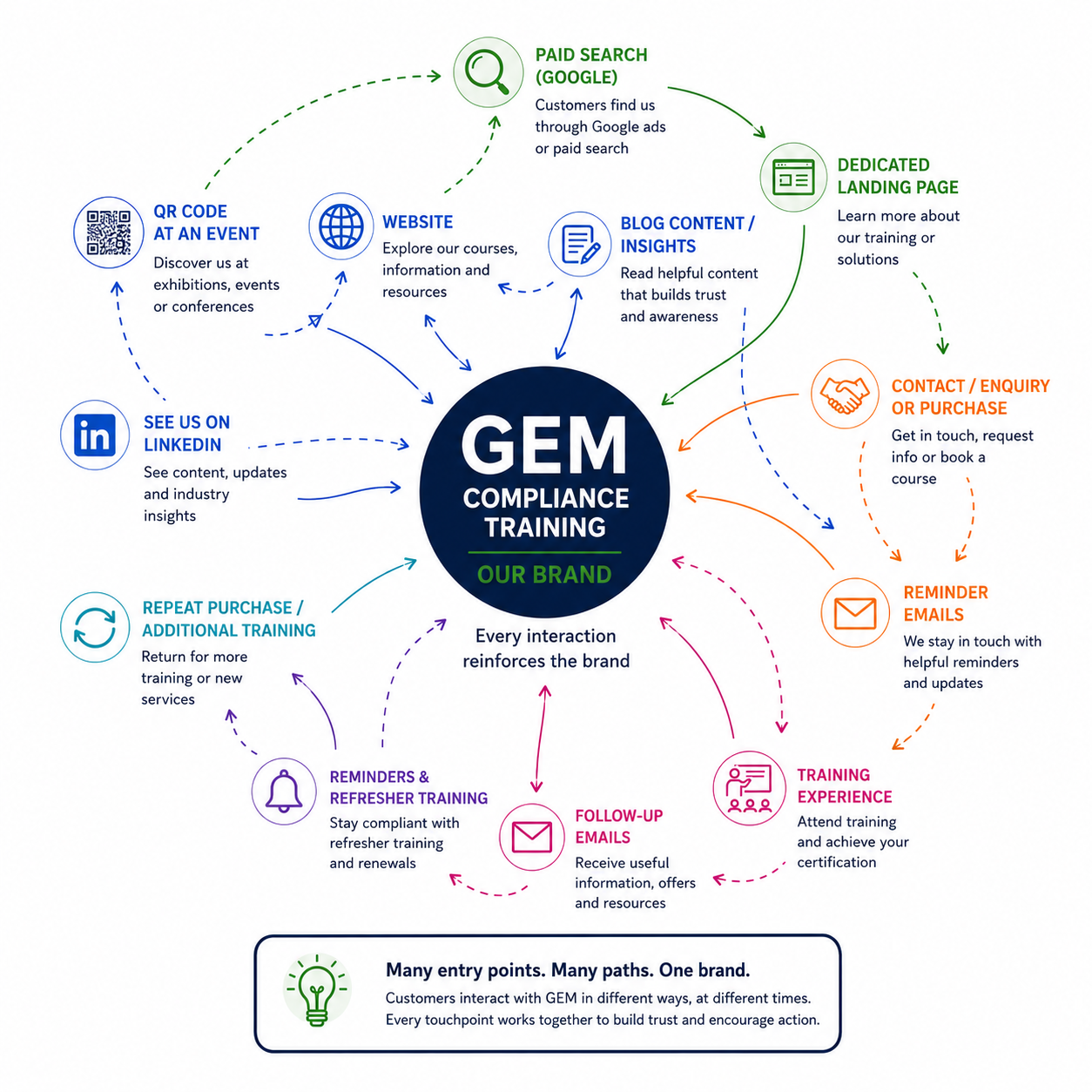
The benefits of this approach became increasingly visible as these changes accumulated across 2025 and into 2026. Compared with the same period in the previous year, website views increased by approximately 110%, event interactions more than doubled and key events increased by over 400%. Bounce rate also fell from approximately 40% to 34%, suggesting visitors were progressing further through the website rather than leaving after viewing a single page. While these improvements reflected the cumulative effect of the wider marketing strategy described throughout this article, they were also consistent with a more integrated customer experience, where each interaction reinforced the next rather than operating as a series of disconnected marketing activities.
Ultimately, customers don't experience blogs, emails, adverts and social media posts as separate marketing activities. They experience one organisation. Organising our work around campaigns rather than channels simply allowed our marketing to reflect the way customers were already interacting with the business.
Build relationships, not transactions
Organising our marketing around customer problems changed more than the way we planned campaigns. It also changed the way we thought about growth.
Acquiring new customers will always remain essential, but it is also one of the most resource-intensive aspects of marketing. Every new customer must first discover your organisation, compare alternative providers and develop enough confidence to make an enquiry. Our customer journey research had shown that one of the largest groups of customers already knew both GEM and the training they required before they reached our website. While continuing to attract new customers remained important, we recognised that organisations who had already experienced our training represented a different opportunity. Rather than continually investing all of our effort into moving new customers through the earliest stages of the buying journey, we increasingly focused on strengthening relationships with those who already trusted GEM and finding new ways to increase the value they received from choosing us.
By this stage, we had a much clearer understanding of our customers. Branded searches continued to increase, direct website traffic had grown significantly and returning visitors were becoming more common. Nearly 2,000 Google reviews consistently reinforced the same message: customers valued not only the quality of the training itself, but also the professionalism of the trainers, the responsiveness of the office team and the support they received before, during and after their course.
It further reinforced that customers weren't evaluating individual campaigns or even individual courses. They were evaluating their relationship with GEM.
Rather than viewing a booking as the end of the relationship, we looked for opportunities to increase the value customers received at every stage of their experience with GEM. The Arlo training management system, with built-in CRM and automation tools, made this possible in practice. By automating post-booking communications, refresher reminders and wider training recommendations, delegates received consistent, personalised support before, during and after their course without manual follow-up on every contact. Arlo's remarketing tools also helped us re-engage past customers at the right moment, and its platform underpinned our move into blended learning, giving customers more flexible ways to complete their training. Alongside this, we introduced exclusive partnership offers for existing customers, flexible payment arrangements and more tailored booking journeys based on customer feedback.

The commercial impact became increasingly visible over time. During the same period, spend from existing customers increased by approximately 265%, suggesting that organisations were not simply returning to purchase another course, but were entrusting a greater proportion of their training requirements to GEM. In the end, sustainable growth wasn't driven by finding more ways to sell training. It came from finding more ways to create value for the organisations that had already chosen GEM. Marketing may introduce someone to your business, but the experience you provide determines whether they choose to come back.
Conclusion
Looking across these four lessons, a common theme emerges. Each challenged an assumption about how marketing should work. We shifted our focus from promoting individual courses to building a recognisable brand, from relying on isolated metrics to making evidence-based decisions, from treating channels as separate activities to planning integrated campaigns, and from focusing primarily on acquiring customers to strengthening long-term relationships.
None of these changes happened overnight, and none represented a single solution to growth. Rather, they reflected a gradual change in how we understood our customers, measured success and prioritised our efforts. Arlo gave us the platform to act on that thinking - CRM, remarketing and blended learning delivery among them - but the decisions themselves had to come first. Collectively, they helped us build a marketing function that was more focused, more strategic and better aligned with the wider objectives of the business.

.png)