
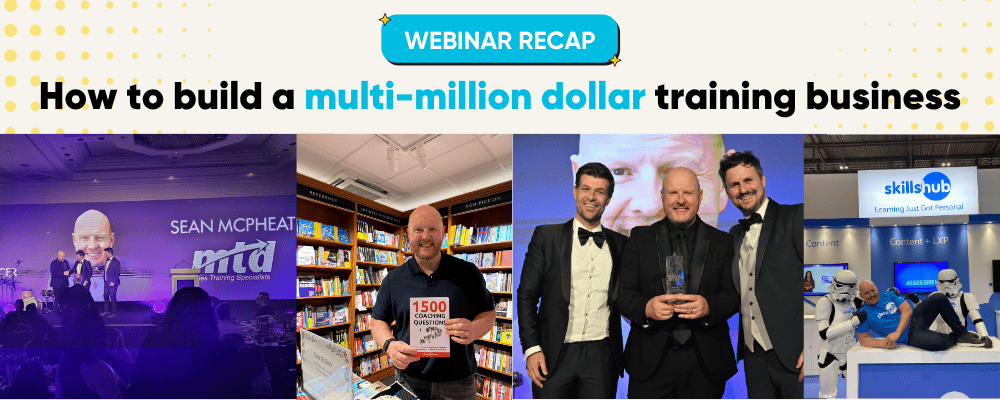
In Arlo’s recent webinar, Sean McPheat unpacked why so many training businesses stall once growth depends too heavily on the founder and the operational, commercial, and delivery shifts required to scale beyond that ceiling.
There’s a point many training businesses eventually reach where growth starts creating more problems than momentum.
More courses mean more coordination. More admin. More scheduling. More delivery pressure. And more dependence on the founder to keep everything moving.
In Arlo’s recent webinar, MTD Training and Skillshub Founder & CEO Sean McPheat shared an honest look at what it actually takes to scale a training business beyond that point. Having built not one but two multi-million pound training companies, Sean unpacked the operational decisions, delivery shifts, and mindset changes that helped MTD evolve from a founder-led business into a scalable learning organization.
One idea came through clearly throughout the session: The training companies that scale aren’t simply the best trainers. They’re the ones that build the best business models.
Here are five of the biggest lessons Sean shared on building a training business that can scale sustainably.
1. Remove the founder as the bottleneck
Sean opened the webinar with an uncomfortable truth many training providers will recognize immediately: Most training businesses never scale past the founder.
In the early stages, that dependence often feels unavoidable. The founder delivers the training, wins the work, manages the clients, creates the materials, and keeps the business moving. But eventually the model starts to hit a ceiling.
Sean described experiencing exactly this himself during MTD’s early growth years. Revenue plateaued because the business relied too heavily on him personally. If he stopped delivering, sales slowed. If he stepped away, operations stalled.
The turning point came when he realized growth wouldn’t come from simply working harder. It required redesigning the business itself.
That meant hiring earlier, standardizing delivery, documenting processes, and gradually removing himself from day-to-day operations. Not because he wanted to stop being involved, but because the business couldn’t scale while everything depended on one person.
Over time, MTD also shifted toward more repeatable delivery models across programs like its MTD Sales Training, helping reduce operational complexity while maintaining consistent learner outcomes.
As Sean put it during the session: “If you want to scale your business, you are the biggest bottleneck.”
For many training providers, that’s the hardest shift of all. But evolving from expert practitioner into business builder is a necessary step in scaling your training business.
2. Build scalable systems before operational complexity slows you down
One of the strongest themes throughout the webinar was the role operational systems play in sustainable growth.
As training businesses expand, complexity compounds quickly.
Registrations. Payments. Learner communications. Scheduling. Reporting. Certifications. Trainer coordination. Blended delivery. Client requests. Follow-up admin.
What starts as manageable spreadsheets and manual processes can eventually become a serious operational bottleneck.
Sean described the point where MTD’s operations began feeling like “organized chaos”.
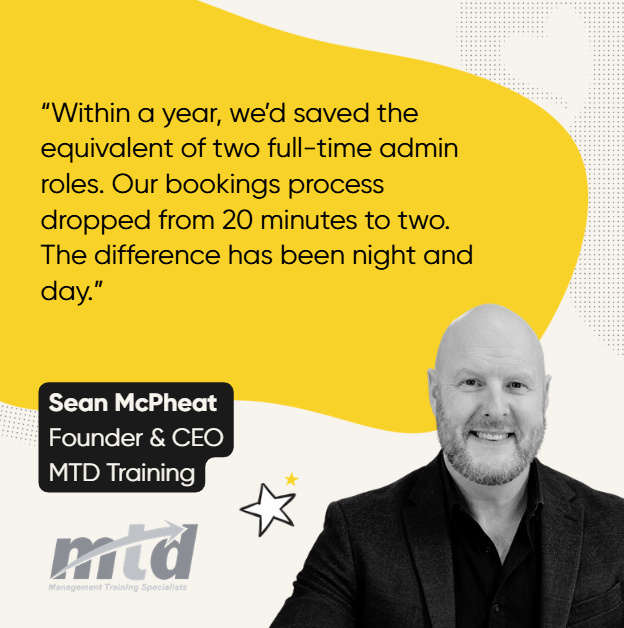
At the time, managing MTD’s growing schedule of public courses involved a significant amount of manual administration behind the scenes. Processes like registrations, invoicing, joining instructions, payment handling, waitlists, and learner communications were all consuming valuable operational time.
As delivery volume increased, the admin burden increased with it.
That changed after implementing the Arlo training management system.
By moving course management, registrations, payments, communications, and scheduling into a single platform, MTD significantly reduced operational friction across the business.
The results were substantial:
- a 25% increase in registrations
- 70% of registrations paid online upfront
- more than 80 hours of administration saved every week
Importantly, Sean said the goal wasn’t simply reducing admin for the sake of efficiency.
It was creating capacity for growth.
Instead of spending time managing repetitive operational tasks, the team could focus more heavily on client relationships, learner experience, and business development.
“Systems create freedom,” Sean said during the webinar.
That idea resonates strongly across growing training businesses. Scaling isn’t simply about adding more trainers or running more workshops. It’s about building operational foundations that allow growth to happen without overwhelming the team behind it.
Read the full case study here.
3. Use blended learning to increase value and revenue
For years, instructor-led training largely followed the same format: workshops delivered in a room over one or two days.
But learner expectations have changed. Organizations increasingly expect flexibility, reinforcement, and ongoing learning support beyond a single classroom event.
Sean argued that blended learning isn’t simply a learning design decision anymore. It’s a commercial growth strategy.
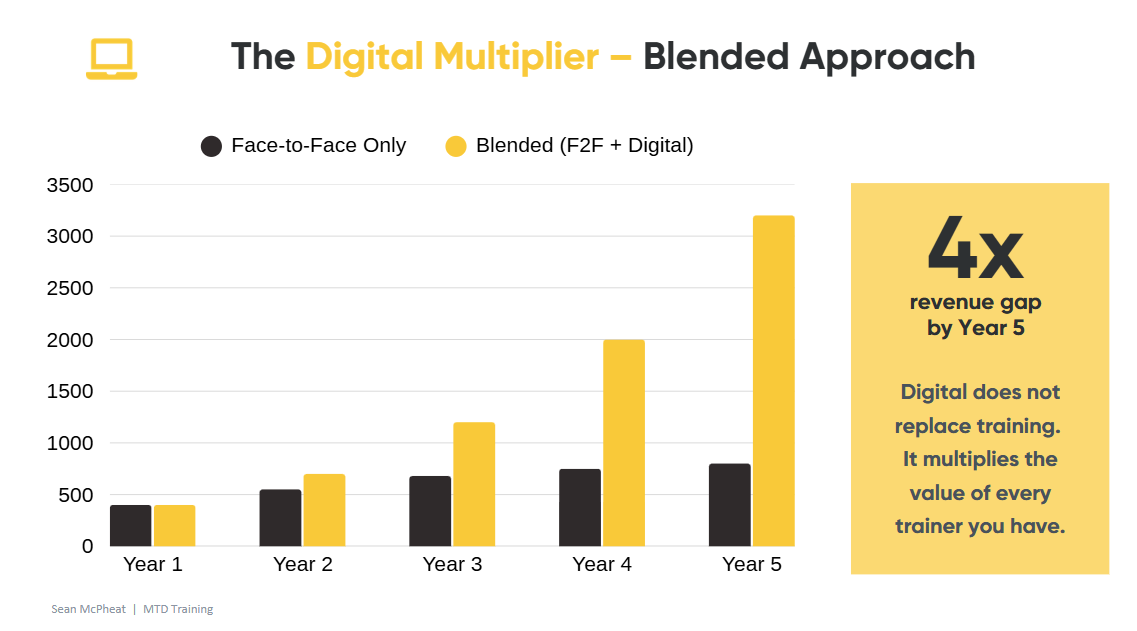
He shared a simple example comparing a traditional two-day workshop model against a blended approach that incorporated digital learning, reinforcement, coaching, and follow-up learning touchpoints.
The result wasn’t just improved learner engagement.
It also significantly increased the commercial value of the program.
“Digital is not a nice to have, it’s a money multiplier.”
What made Sean’s perspective particularly interesting was that he didn’t frame blended learning as replacing instructors. Instead, he described it as extending and amplifying the impact of instructor-led delivery.
“Training is just an event. Learning happens in the work.”
That distinction matters.
The most effective training providers are increasingly building learning ecosystems around workshops by combining live delivery with digital learning, coaching, reinforcement, assessments, communities, and performance support.
For training businesses, this creates a powerful opportunity to increase learner value while also building more scalable revenue models.
For Sean, the results were substantial - there was a 4x revenue gap by year 5.
4. Hire earlier than feels comfortable
Sean was refreshingly candid about mistakes he made while growing MTD, particularly around hiring.
One of the biggest? Waiting too long to hire more staff.
Like many founders, he initially tried to hold onto too much responsibility himself. But eventually he realized the business could only grow if he stopped doing everything personally.
His first key hire was an associate trainer, which allowed him to focus more heavily on sales and business development. Later came leadership hires across sales, operations, and learning delivery.
Importantly, Sean acknowledged that stepping back wasn’t easy. In one example, he described how sales performance initially dropped after appointing a Head of Sales. His instinct was to jump back in immediately.
Instead, he stayed patient, coached the new leader through the transition, and gave the role time to mature.
Eventually, sales surpassed previous levels.
That experience fundamentally changed how he approached scaling.
Rather than hiring only for experience or impressive CVs, Sean said he now prioritizes attitude, adaptability, and willingness to learn, particularly in growing businesses where flexibility matters.
For smaller training providers especially, the lesson was clear: Growth often stalls not because demand disappears, but because founders struggle to let go soon enough.
5. Build a business that goes beyond workshops
Toward the end of the webinar, Sean introduced an idea that sat underneath much of the conversation: the evolution from “training company” to “learning ecosystem”.
In practical terms, this means expanding beyond traditional delivery models and building multiple layers of value around training.
That could include:
- digital learning libraries
- certifications
- licensing models
- coaching
- advisory services
- intellectual property
- assessments
- communities
- SaaS products
“The higher you go up the ladder, every rung represents a revenue multiplier.”
For Sean, long-term growth comes from creating value that isn’t solely dependent on trainer hours or classroom delivery.
That doesn’t mean abandoning instructor-led learning.
It means building a broader, more resilient business model around it.
And in a market where learner expectations, delivery models, and operational complexity are all evolving rapidly, that shift is becoming increasingly important.
Final thoughts
There was a consistent thread running throughout the webinar: scaling a training business requires a different mindset from starting one.
The early stages reward hustle, expertise, and responsiveness. But sustainable growth demands systems, delegation, operational discipline, and scalable delivery models.
Or as Sean put it: “Don’t work in your business. Work on your business.”
For training providers navigating growth, that may be the most important lesson of all.
Watch the full webinar replay here.

.svg)
.png)