
.png)
Most training businesses don’t wake up one day and realize their operations are broken. The problems usually show up gradually with a few extra spreadsheets., longer email threads, and more manual copying and pasting data between systems.
At first, it feels manageable. Maybe you hire another admin. Maybe you invest in online booking tools.
But as delivery grows across trainers, learners, private clients, locations, and delivery formats, small operational gaps start compounding quickly.
Here are some of the clearest signs your training business may have outgrown the systems and processes holding it together.
1. Your admin team spends most of the day coordinating updates
A learner transfers courses. A trainer changes availability. Someone needs joining instructions before tomorrow morning’s session. A private client wants to add more attendees at the last minute.
None of these tasks are unusual.
But when your team spends most of the day manually coordinating information between people, inboxes, spreadsheets, and disconnected systems, operations start slowing the business down.
Modern training businesses reduce that coordination pressure by connecting scheduling, registrations, communication, certificates, trainers, venues, and reporting into one workflow.
With Arlo, training teams can manage delivery from a single platform instead of stitching together multiple operational systems behind the scenes.
2. Your blended learning experience feels disconnected
Most training businesses are no longer delivering training in just one format.
A learner attends a live workshop, completes elearning before the session, downloads resources afterwards, then returns weeks later for assessments or follow-up learning.
But behind the scenes, those experiences are often spread across disconnected systems.
- Registrations live in one platform, or in spreadsheets.
- Virtual delivery happens somewhere else.
- Elearning sits in a separate LMS.
- Assessments are managed manually.
- Learner progress gets tracked in spreadsheets.
The result is a learning experience that feels fragmented for both learners and training teams.
Learners struggle to find what they need. Trainers lack visibility into learner progress before delivery starts. Admin teams spend time manually connecting systems and updating records across platforms.
Arlo brings instructor-led training, virtual delivery, elearning, assessments, learner records, communication, and reporting into one connected workflow. Learners move through one connected experience, while training providers keep visibility across the entire journey.
That means:
- trainers can see learner progress before delivery
- learners can access training, assessments, and records in one place
- admin teams avoid manually coordinating disconnected systems
- reporting stays connected across delivery formats
The goal is not just offering more learning formats.
It’s creating a seamless blended learning experience for your learners, and more manageable workflows for your training business.
3. Trainers rely on inboxes to prepare for delivery
Great trainers need more than course materials.
They need accurate schedules, learner information, attendance tools, joining instructions, assessments, and visibility into changes before delivery begins.
When that information is spread across inboxes, PDFs, spreadsheets, and last-minute messages, delivery becomes harder than it needs to be.
Small operational gaps create friction quickly. An outdated attendee list. Missing learner context. A schedule change that never reached the trainer properly.
Arlo keeps trainer schedules, attendance, communication, learner information, and delivery details connected to the wider training operation so trainers can focus on delivery instead of chasing updates.
4. Your public training runs smoothly, but private training still runs through email
Most training businesses eventually build decent systems around public course delivery.
Bookings are automated. Communication is scheduled. Registrations flow cleanly.
But private training often lags behind and stays manual for much longer:
- Client updates happen over email.
- Attendance changes get coordinated manually.
- Learner progress requests come through account managers.
- Repeat bookings start with long email threads.
As private training grows, that creates a second operational workflow inside the business… one that depends heavily on manual coordination.
That’s where a lot of scaling friction starts appearing.
Arlo brings public and private training into the same connected operational workflow. Scheduling, learner management, trainer coordination, reporting, ecommerce, communication, and client visibility all stay connected inside one system.
With the Organization Portal, private clients can also:
- view upcoming private courses
- manage attendees
- track learner progress
- access certificates
- request additional training
…without relying on your team for routine updates.
That reduces operational overhead while creating a more scalable way to support and grow private training relationships.
Learn more about the Organization Portal.
5. Learners struggle to find important information
A missing reminder email. Confusing joining instructions across multiple platforms. No visibility into certificates or progress.
These moments feel operational internally, but learners experience them as training quality problems. It affects their experience with your training business, makes them less likely to recommend you, and less likely to return for future courses.
As instructor-led, blended, virtual, and self-paced elearning continue to overlap, learner expectations are changing too. People expect training experiences to feel connected, clear, and easy to navigate.
Arlo helps providers create consistent learner experiences across booking, communication, elearning, assessments, certifications, and learner records through connected learner portals and automated communication workflows.
6. You’re copying the same information across multiple systems
Updating learner records manually. Re-entering trainer information. Duplicating communication across systems. Exporting reports into spreadsheets just to make them useful.
Disconnected systems create duplicate work fast.
Arlo connects registrations, scheduling, trainers, communication, learner records, certificates, reporting, and finance workflows into one platform so information stays connected across the business.
That reduces manual updates and gives teams a more accurate operational view of the business.
Learn more about Arlo integrations and workflows.
7. Reporting takes longer than it should
Most training providers can see bookings.
Far fewer can easily see:
- profitability
- repeat business
- revenue by delivery format
- client growth
- operational performance
That makes growth decisions harder than they need to be.
Arlo connects bookings, delivery, clients, and revenue into one reporting layer so providers can understand not just what sold, but what is worth growing.
Learn more about reporting and insights in Arlo.
8. Growth stalls because of admin pressure
More courses should create growth.
But growth also comes with more administration. More coordination, more communication, more manual work and more operational overhead.
At a certain point, scaling becomes difficult because operations rely too heavily on manual effort.
Arlo helps providers reduce that operational pressure through automation, centralized workflows, connected communication, scheduling controls, and self-service experiences for learners and clients.
9. Your team spends more time managing systems than improving delivery
When operations become fragmented, teams spend more energy chasing updates, fixing issues, and manually coordinating delivery instead of improving learner experience, growing accounts, and strengthening training quality.
The strongest training businesses reduce operational friction by connecting the systems behind delivery instead of layering more disconnected tools onto the business over time.
Arlo is designed specifically for training providers, bringing together course management, scheduling, communication, learner management, ecommerce, reporting, and private training workflows into one platform.
So you can spend more time delivering impactful learning.
10. Your business still depends too heavily on the founder
This is one of the biggest signals for up and coming training businesses.
Founders are often involved in every decision. Their name's on every client. Nothing moves without them and it becomes a bottleneck.
At first, that can feel like quality control for founders.
But over time, it becomes something else: the business depends on one person holding everything together behind the scenes.
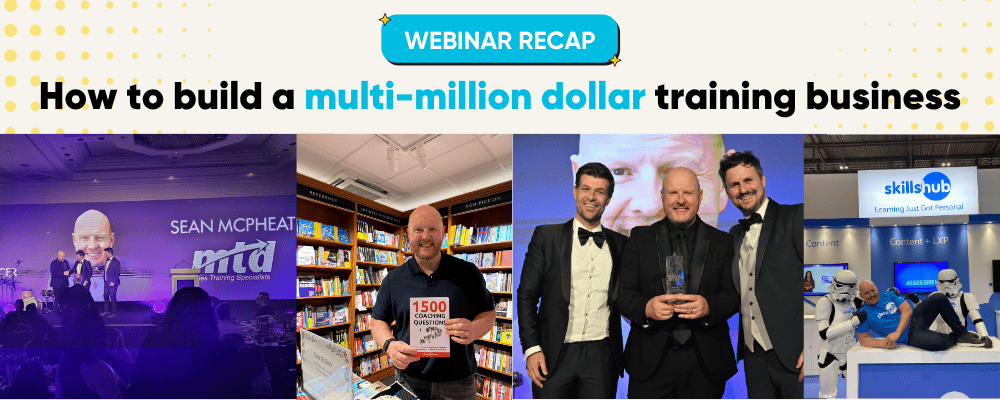
That’s one of the biggest challenges Sean McPheat talks about when scaling MTD Training into a multi-million dollar training business. The turning point wasn’t just selling more training. It was building systems, workflows, and operational visibility that allowed the business to scale beyond the founder.
Because instructor-led training becomes very difficult to scale when too much knowledge, coordination, and decision-making sits with one person.
The key is in making sure growth does not depend on one person manually holding the operation together behind the scenes.
And that’s where Arlo helps training providers like Sean and MTD create that operational foundation by connecting scheduling, communication, reporting, learner management, ecommerce, and delivery workflows into one system designed specifically for training businesses.
Watch the on-demand webinar with Sean McPheat on scaling a modern training business.
The best training businesses reduce operational friction as they scale
Training businesses rarely struggle because the training itself is not valuable.
More often, growth exposes operational gaps between systems, people, communication, and delivery.
The providers growing fastest are usually the ones reducing those gaps early - by connecting scheduling, communication, trainers, learners, reporting, ecommerce, and private training operations into one workflow that scales with the business.
.svg)