
This post is part of a series on findings from the State of Instructor-Led Training 2027 report. The report is the first global benchmark built specifically for ILT providers, produced by Arlo with The Training Marketplace. It combines responses from training providers around the world, buyer search data, and commentary from an advisory panel of industry leaders. All figures below are shares of the providers who answered each question.
On 12 November, Donald H. Taylor hosted Tammy Banks, Melissa Satterfield and Scott D’Amico to unpack the findings from the State of Instructor-Led Training 2027 report.
A benchmark is useful, but it gets more useful when practitioners read it out loud and argue about it. That is what happened in our first live panel.
1. The numbers that surprised people
Donald opened by asking which number surprised the room most. Two came up again and again.
The first was profit. 53% of providers raised prices over the last three years, but profit rose for only 31%. One of the attendees, Susan, a leadership trainer from Canberra, said profit surprised her most, and Donald agreed. Another attendee, George, read it as a sign that providers need to look beyond price: “focus more on efficiency, value and sustainable growth.”
The second was measurement. Tammy’s pick was the 17% of providers who are extremely confident they can measure the impact of their training.
“It kind of hurts slightly when I see only 17% of people feeling confident about that, because I think that’s the part that connects a few of these together. If people had more strength and confidence in proving their worth, their difference, really being able to evidence the impact of what they do, then I think it would very much filter into quite a few of these other things.”
2. AI is mostly behind the scenes
94% of providers use AI somewhere in their organization. 72% use it for content creation, but only 42% use it for learner-facing personalization.
The chat showed why that gap exists. Viv shared that two multinational clients had each asked her where to learn about AI and when to use it. Susan described organizations so focused on working out how to manage AI that other L&D work is being deprioritized. As we said on the call, it is changing so fast that it is hard to write a playbook.
Scott D’Amico, General Manager of Certification at PSI, linked the AI numbers to pricing: “The lion’s share of that is coming from content creation, which ultimately brings down the barriers to entry into the training and development industry. We’re seeing a lot more providers coming out with content that may not ultimately drive behavioral change.” His answer was to focus on how you drive behavior change in the classroom, and how you demonstrate and measure it.
Asked what will have changed by November 2027, Tammy kept it short: “We’re much clearer about our value against AI.”
Dez, a freelance facilitator, summed up the other side: with the rise of AI, “people want to be seen, heard and listened to.”
3. Demand is the problem, and word of mouth is the answer
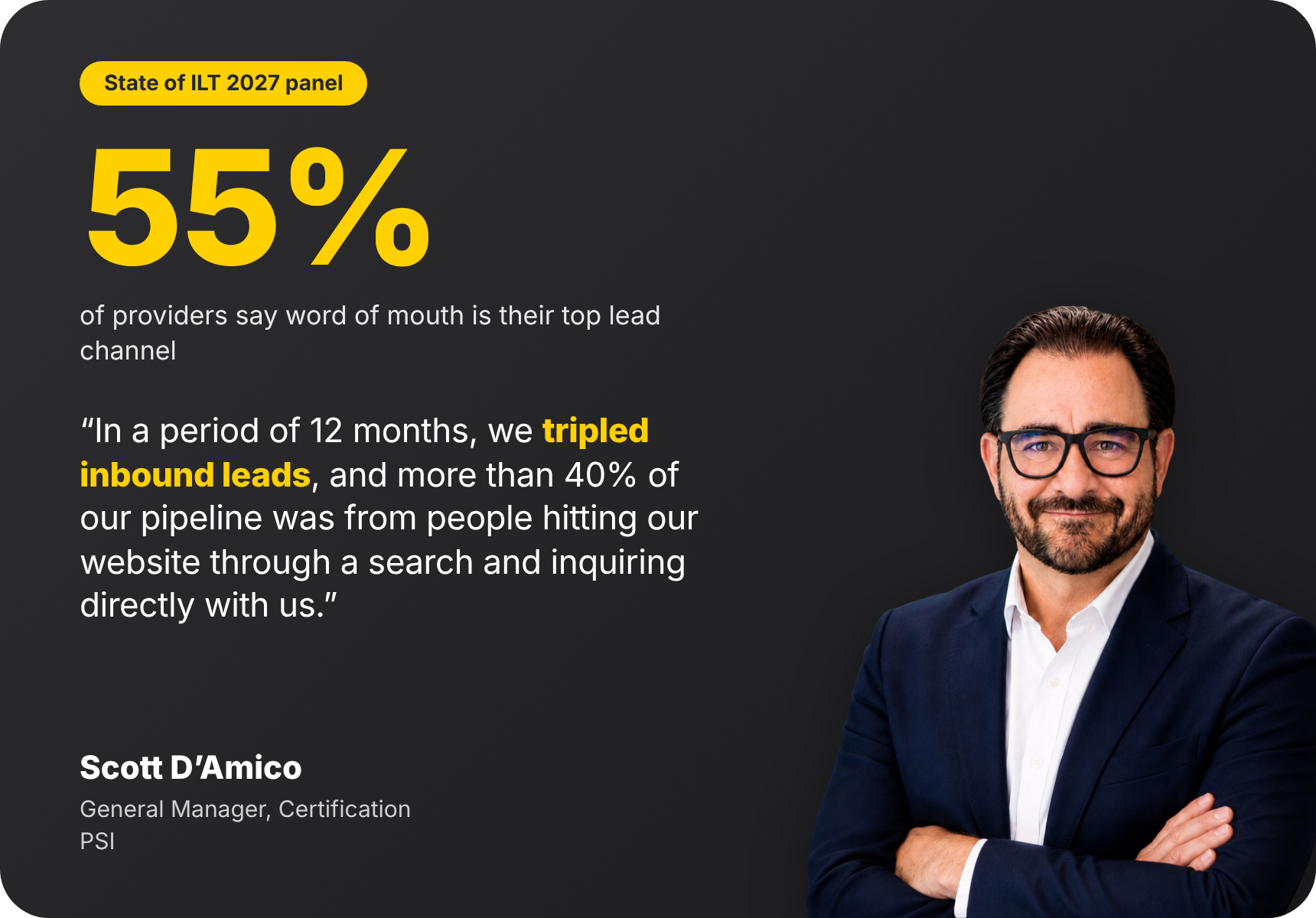
Generating demand is the top challenge for providers, named in the top three by 41.9%. Adapting to AI came second at 38%. Word of mouth is the top source of qualified leads at 55%, more than the next two channels (partnerships and email) combined.
Susan said slow decision making in the public sector is hurting demand, and in the private sector she sees buyers overwhelmed by AI, cyber security and change. Tammy added that tenders and procurement are feeling harder at the moment. Scott shared what worked at his previous organization: “In a period of 12 months, we tripled inbound leads, and more than 40% of our pipeline was from people hitting our website through a search and inquiring directly with us.” His advice: “Build your voice, focus heavily on organic AI SEO.”
Tammy said people are tired of sales posts and want you to “lead with a game-changing quote, some impact, something that catches their eye.” On why word of mouth works, she recalled learning that people need to see you “at least 11 times before they start to know, like, trust you.”
A practical tip from Tammy for smaller organizations without a big social following or an ad budget: focus on a group. Join the groups where your buyers already are, and answer people’s concerns there, rather than posting openly to everyone.
The report also shows why open courses are worth keeping even when private training is where the margin is. Among providers who run both, private is named more often than public for revenue (50% vs 26%), profit (51% vs 26%) and repeat bookings (47% vs 26%). Public leads on lead generation (41% vs 30%).
Open courses build trust, and trust brings in the in-house work. Scott described open enrollment courses as loss leaders: one registration where “maybe we didn’t make a bunch” turned into “a $150,000, $200,000 opportunity down the road” because the buyer had experienced his team’s facilitators. Melissa and Tammy added a caution. Both said public workshops have been hard to bring back since the pandemic.
4. Measurement: attendance is not impact
42% of providers are extremely or very confident they can measure the impact of their training (17% extremely, 25% very). The two biggest challenges are measuring long-term learning impact (61%) and demonstrating ROI to clients (45%).
On evidence, 63% of providers use certificates of completion, but only 16% give employers a competency report. A certificate proves attendance, not impact.
Melissa Satterfield said it starts with a training needs analysis: “Once you’re able to identify the root cause with the help of your client, then it’s really easy to say, based on the information you gave me, here’s where the problem lies. They can’t argue with their own data.”
Scott added a way to frame it for buyers. Purchasing decisions typically fall into five buckets: productivity, income, expenses, the reputation of the company, and the safety and security of employees. Quantify the impact on those and the conversation changes: “This $15,000 training can fix a $250,000 problem.”
Viv put the cause plainly. L&D has often been an order taker: people ask for training and we don’t ask what problem they are trying to solve. Her answer was to gather better data, build a solution that goes beyond a workshop, and measure the impact.
On needs analysis, Tammy’s advice was to be proportionate. Some of her needs analyses are a conversation, others are a form, a focus group, a detailed assessment or a survey.
5. Blended learning is growing, but slowly
58% of providers now offer blended learning, but 45% of them deliver only a quarter or less of their courses that way. The top challenge is maintaining engagement across formats (54%).
Asked for one piece of advice for a first blended course, Tammy said: “Be clear on who your customer is first and whether they actually want it.” Scott warned that “instructor-led courseware doesn’t directly translate into a virtual world,” and Melissa said to choose the right content for the synchronous portion and the right content for the asynchronous portion.
Looking a year ahead, Melissa expects that “hybrid training is not just going to be a niche delivery method. It’s going to be the norm.”
Thank you
Thank you to Donald for hosting, to Tammy, Melissa and Scott for their time and expertise, and to everyone who joined and shared their experience in the chat. Thank you also to our partners and advisory panel, who helped make the report possible.
Read the report
The survey figures in this post come from the State of Instructor-Led Training 2027 report. It is free to download, so you can hold the data up against your own training operation.
Download the State of Instructor-Led Training 2027 Report